
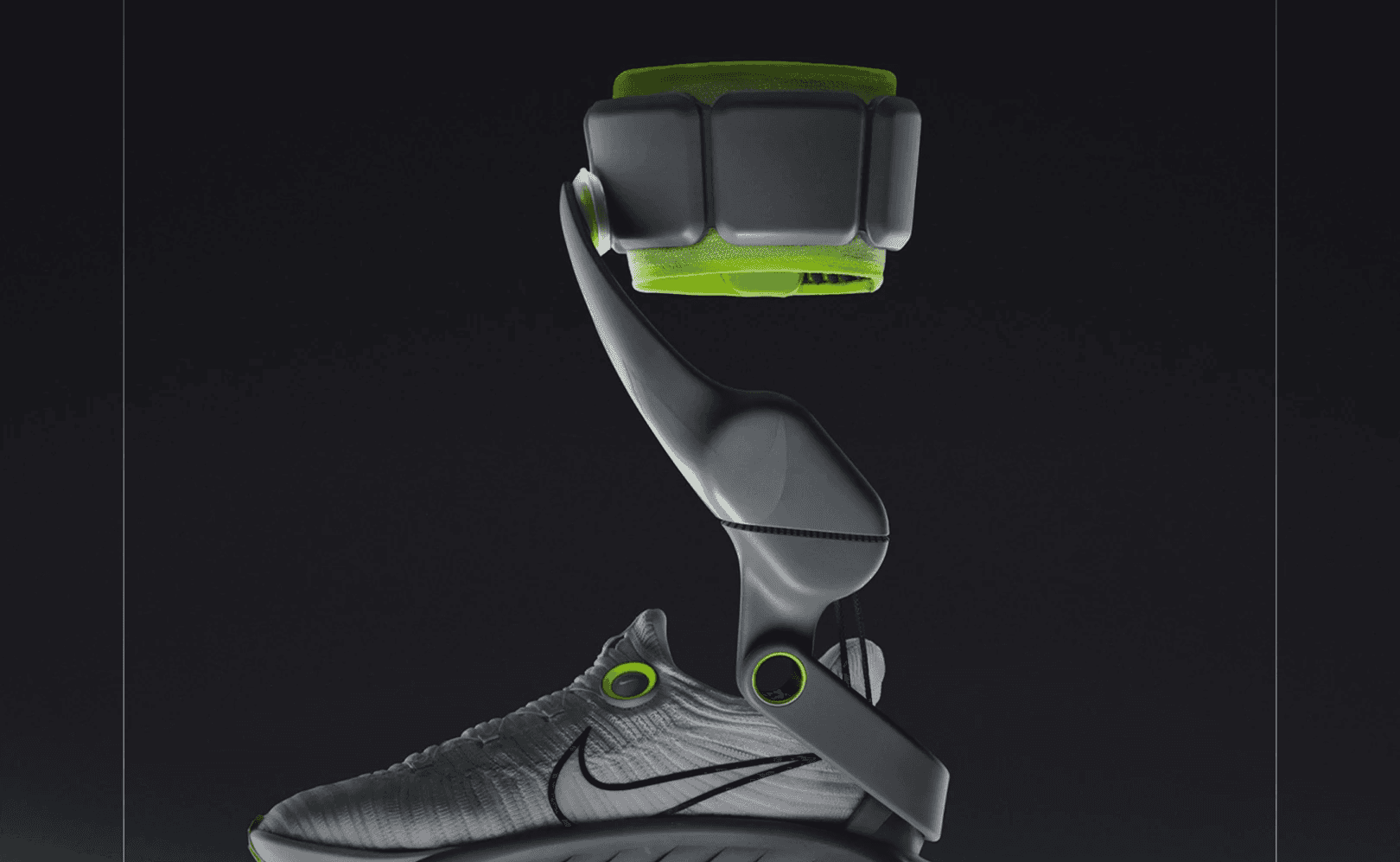
“If you have a body, you are an athlete.” That declaration opens Nike’s latest innovation, Project Amplify, described as the world’s first powered footwear system for running and walking.
According to the company, the system is designed not for elite racers but for everyday runners, commuters, and fitness enthusiasts. It aims to help users go faster and farther with less effort while keeping the natural movement of running intact.
What is Project Amplify?
Project Amplify is a wearable robotic assistance system developed by Nike in collaboration with robotics company Dephy. The system combines a cuff-like battery worn around the lower leg with a motorised drive belt that connects to a carbon-fibre-plated running shoe. The shoe can function independently or with the powered component attached.
Nike explains that Project Amplify enhances the natural motion of the lower leg and ankle, essentially providing “a second set of calf muscles.” The system supports walking, jogging, or running by adding subtle, mechanical assistance to each stride.
According to the company, the technology is tuned for users running at a pace of about 10 to 12 minutes per mile, making it more suited to casual runners and daily movement rather than competitive athletes.
More than 400 testers have participated in development trials, logging over 2.4 million steps across nine hardware versions. The system remains in the prototype phase, with a commercial launch expected in the coming years.
Why It Matters
Project Amplify marks a convergence between robotics, wearable assistive technology, and consumer athletic gear.
While powered exoskeletons have been used in industrial and medical contexts, Nike’s entry brings this concept into mainstream sportswear.
The innovation aims to make walking and running less strenuous, helping users maintain endurance and reduce fatigue. Early testers reported that uphill running “felt like moving on flat ground,” suggesting potential benefits for both fitness and mobility.
By integrating assistive motors, sensors, and algorithmic controls into footwear, Nike is redefining how technology can complement the human body in motion not to replace effort, but to enhance it.
Company Statements
Michael Donaghu, Nike’s Vice President of Create The Future, Emerging Sport and Innovation, said:
“Our job is to dream big while keeping athletes at the center. Project Amplify started with a single question: what if we could help athletes move faster and farther with less energy and a lot more fun? At its core, Project Amplify is about seamlessly adding a little more power to your stride. The fun comes from realizing you can do more than you thought you could — whatever ‘more’ means to you.”
He added that the first-generation product is not aimed at competitive runners chasing speed records but at those who want to experience smoother, longer, and more efficient everyday movement.
The World’s First?
Nike’s claim of unveiling the “world’s first powered footwear system for running and walking” comes with some context.
Powered exoskeletons and lower-leg assistive devices have long existed in industrial and rehabilitation settings. Dephy, Nike’s robotics partner, has worked on similar biomechanical systems for walking assistance.
However, Project Amplify differs in its design and audience. It combines assistive robotics with consumer-grade footwear, targeting recreational users rather than clinical or industrial environments.
The only remotely comparable Nike innovation is the HyperAdapt 1.0, introduced in 2016 as the brand’s first self-lacing shoe. But Project Amplify goes further by introducing active mechanical power assistance rather than passive or automated fit technology.
Ease from Tech
The success of Project Amplify will depend on overcoming key challenges:
• Weight and Comfort — making the device light and flexible enough for daily use without feeling restrictive.
• Battery Performance — ensuring that power systems last through runs or commutes without frequent recharging.
• Affordability and Accessibility — determining whether everyday users can afford a product that merges robotics and sportswear.
• Regulation and Fair Use — establishing how assisted footwear fits into competitive or semi-competitive running environments.
Nike has not yet confirmed pricing or availability, but indicated that a launch could happen “in the coming years.”
Project Amplify represents a major leap in the evolution of athletic footwear. By merging robotics with human biomechanics, Nike is expanding what performance innovation means from material engineering to mechanical assistance.
If successful, the technology could reshape not only how people run but also how they move through their day. In a world where technology increasingly augments the human body, Nike’s message remains simple: if you have a body, you are an athlete — and now, your shoes might just have power too.