Policy

Oluwaseyi Amosun
Jan 7, 2026
Just as Game of Thrones warned that “Winter is coming,” Nigeria now faces a transformative economic season. Tax Reform is coming in 2026. And like all seasons, it brings both challenges and opportunities.
What’s changing is not just numbers on paper, but the architecture of how tax is understood, calculated, collected, and enforced across the economy.
On June 26, 2025, President Bola Tinubu signed four landmark tax laws that collectively scrap and replace more than a dozen outdated statutes, streamlining taxation, modernising compliance, and broadening the revenue base for the first time in decades.
1. The Four Pillars of the New Tax Regime
These Acts are the heart of the overhaul:
1. Nigeria Tax Act (NTA) — a unified code that replaces many legacy tax laws.
2. Nigeria Tax Administration Act (NTAA) — sets the rules and digital tools for tax administration nationwide.
3. Nigeria Revenue Service Act (NRSA) — dissolves the old FIRS and creates the Nigeria Revenue Service, a modern federal tax agency.
4. Joint Revenue Board Act (JRBA) — aligns federal, state, and local tax authorities and builds mechanisms for dispute resolution.
Implementation started 1st January 2026.
2. What Nigerians Will Actually Experience
For Individuals
Tax Relief and Fairness
If you earn below ~₦800,000 per year, you pay 0% tax.
The income tax structure becomes progressive: higher earners pay more, but only after clear thresholds. (
Rent relief (a portion of actual rent) can be deducted, capped at set limits, reducing taxable income further.
Because of these rules, about 98% of Nigerians won’t pay PAYE directly once the laws kick in.
Why this matters
This shift transforms tax from something abstract and punitive into a system that puts ordinary people first, making sure low‑income workers contribute fairly without overburdening them.
For Freelancers, Remote Workers, and the Informal Sector
Yes, freelancers and remote income are now firmly inside the tax net. Digital and remote earnings are treated as taxable income if tied to Nigeria.
This is huge because historically, many such incomes flew under the radar. Going forward, digital earnings will be tracked, reported, and taxed under the same modern framework that now underpins the formal sector.
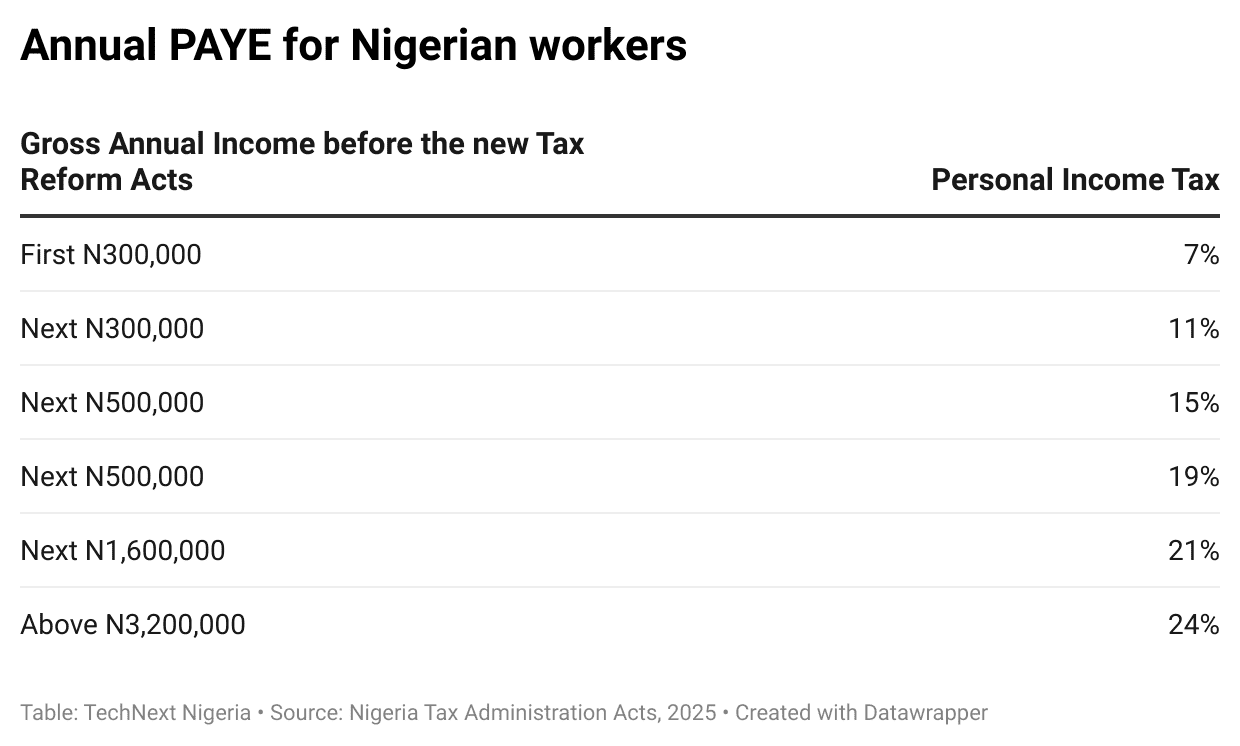
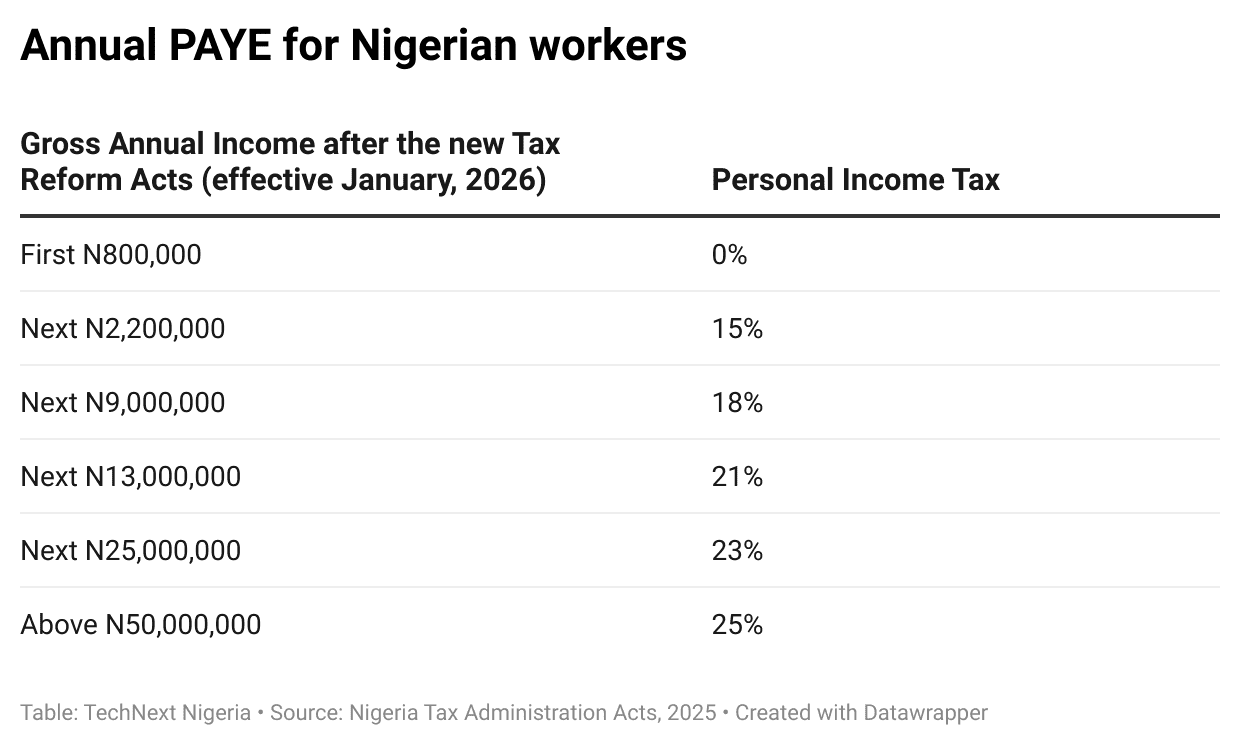
For example (Hypothetical Taxable Income of N3,500,000):
First N800,000: N800,000×0%=N0
Next N2,200,000 (N3,000,000−N800,000): N2,200,000×15%=N330,000
Remaining N500,000 (N3,500,000−N3,000,000): N500,000×18%=N90,000
Total PIT Payable: N0+N330,000+N90,000=N420,000
3. Businesses: Winners and New Rules
Small Businesses
Companies with turnover ≤ ₦50m and fixed assets ≤ ₦250m are fully exempt from corporate tax, capital gains, and the development levy.
Simplified filing and digital compliance make life easier for MSMEs.
This means small enterprises have space to grow without fear of early‑stage tax pressure.
Medium & Large Companies
Corporate Tax Structure
Corporate tax stays, but there’s a twist: a 15% minimum effective tax rate for corporations with annual revenue above NGN 50 billion or multinational links.
Capital Gains Tax for companies rises from 10% to 30%, aligning it with corporate income tax and reducing loopholes.
A 4% Development Levy replaces several older levies (TETFund, IT levy, NASENI levy, and Police Trust Fund levy), creating one simple charge that funds education, tech, and security priorities.
Why this matters
Large companies can no longer use complex cross‑border structures to evade fairness. The system now embeds global best practices and combats profit shifting.
4. VAT, E‑Invoicing and the Digital Transition
VAT Remains at 7.5%
The standard VAT rate did not change, but administration did:
Real‑time e‑invoicing becomes mandatory.
Expanded input VAT credits now cover services and capital assets.
Zero‑rating covers essentials like food, healthcare, educational materials, electricity transmission, and more.
This shift brings Nigeria closer to global digital tax standards, reducing evasion and increasing transparency.
Tech lens: Imagine every registered business acting as a node on a real‑time VAT network. Transactions flow digitally into the national tax database without manual filing.
5. Governance, Compliance and Taxpayer Rights
Nigeria Revenue Service (NRS)
This is the central hub for federal tax collection. Unlike the old Federal Inland Revenue Service, the NRS is built for digital efficiency and nationwide coverage.
Joint Revenue Board (JRB)
Fosters cooperation across federal, state, and local tax offices. It also:
Creates Tax Appeal Tribunals for legal disputes.
Establishes a Tax Ombudsman — an independent voice for taxpayers.
Tech‑Driven Compliance
Tax Identification Numbers (TINs) are mandatory for all taxpayers — individuals, businesses, and non‑residents deriving income from Nigeria.
The entire compliance chain — from registration to filing, payment, and audits — moves onto digitised platforms.
6. The Road Ahead — What It Means for You
For Individuals
You pay tax if you’re earning above the exemption threshold.
Your system will be digital, transparent, and easier to navigate.
Most everyday Nigerians benefit from reliefs and exemptions.
For Businesses
Digital systems mean less paperwork and faster compliance.
Small business exemptions mean structural breathing room.
Larger enterprises must modernise tax planning to navigate new levies, effective tax rates, and international rules.
For the Economy
The reforms signal a welcome shift toward a 21st‑century tax ecosystem — digital, data‑driven, equitable, and more efficient.
In Nxt Box Terms
This tax reform is not about more taxes; it’s about smarter, fairer, and tech‑enabled taxation. Some will pay less, others more, but everyone will play by clearer, digital rules. It is a move from an opaque system to one built on data, clarity, and consistency.
The winter of tax complexity is ending. In 2026, a new fiscal spring begins — if Nigerians and businesses embrace it, adapt early, and engage with the technology at its heart.
Add‑In: Explainer.ng’s AI Tax Calculator — A First‑of‑Its‑Kind Tool
As part of efforts to make the new tax laws real and personal, Explainer.ng has launched an AI‑powered Personal Income Tax Calculator that helps everyday Nigerians figure out exactly how much tax they’ll owe under the new rules.
https:/explainer.ng/tax-calculator
This tool isn’t just a static table. It uses AI logic to interpret the 2025 tax reforms, ask users for their income and key deductions, and then instantly calculate the tax payable — all in clear, human language.
The tool is designed to demystify tax for the average Nigerian, comparing the old tax regime with the new one so you can see what changes mean for your take‑home pay. It reflects the updated tax bands, reliefs, and allowances under the 2025 Tax Reform Acts and gives you customised results based on your financial inputs.
Explainer.ng’s calculator represents a broader shift in how citizens interact with tax policy — from passive awareness to active engagement. As the reforms unfold from January 2026, tools like this will be vital in helping people understand how rules apply to their own lives without intimidating jargon or guesswork.
Follow us @thenxtbox across all platforms for more explainers, updates, and insights on tech, money, and policy shaping Nigeria’s future.