

Walk into any phone shop on Computer Village in Lagos, River Road in Nairobi, or the phone stalls along Oxford Street in Accra, and you'll see the problem immediately: too many phones and promises, but not enough information on what’s worth buying. Every package has an "AI camera," every salesperson swears their phone lasts two days without charging it, but somehow the phones disappoint within six months.
You already know the story. A battery that dies by 4 pm on a day NEPA decides to test your patience. A "50MP camera" that makes your pictures look blurry and unnecessarily dark. And the day WhatsApp, TikTok, and two banking apps are all installed, it starts lagging. And then there's software support. Some budget phones barely receive updates after a year, right around the time you actually need them to keep working with your banking app.
The good news is that buying on a budget no longer means settling for a disappointing phone. That's where this guide comes in. It cuts through the noise to help you find the budget phones actually worth buying in African markets in 2026, what they cost, what they genuinely do well, and who should skip them.
How we picked these phones
Here are some of the things we considered before making this list:
Availability: It had to be officially sold, or at least widely available through legitimate retailers in African markets, such as Jumia, Slot, Konga, Kilimall, Takealot, or established local phone stores; not a random reseller with a "we import direct" sticker on the door.
Battery performance: It had to offer battery life that holds up in African realities, not just impressive lab-test numbers that fall apart the moment you actually use the phone.
Value for money: The price had to make sense when weighed against the other phones competing in the same price range.
Because prices shift by the week and differ wildly between Lagos, Nairobi, Accra, and Johannesburg, thanks to import duty, VAT, and currency swings, every figure below is a range pulled from multiple retailers as of mid-2026, not a fixed number. Confirm current pricing before you buy, and don't be shy about haggling at physical stores. Nobody pays sticker price everywhere in this market.
Tecno Spark 40 Pro: the phone that gets almost everything right

Image credit: Google
Start with the screen, because that's what you'll notice first. Tecno dropped a proper AMOLED panel into the Spark 40 Pro, with a 144Hz refresh rate and enough brightness to stay readable even when you're checking messages under the midday sun outside a bus stop. Deep blacks, bright colours and seamless scrolling: the kind of display that usually costs more.
That alone would make it a contender, but the battery seals the deal. A 5,200mAh cell paired with 45W charging means the Spark 40 Pro shrugs off a full day of WhatsApp, TikTok, and video streaming without drama, and when it does eventually run low, a quick charge over lunch gets you back in business. The 50MP main camera handles daylight shots well, though it's a single-lens setup, so don't expect the versatility of an ultra-wide for group shots or landscapes.
It's not fully waterproof, so don't test its IP64 rating against a downpour, but it'll survive rain and the odd spill without issue. For students and young professionals who want something that looks and feels a class above its price, this is the one to beat. Expect to pay somewhere between ₦220,000 and ₦290,000 in Nigeria, or around KSh 22,000 to 25,000 in Kenya, depending on the RAM and storage you go for.
Infinix Hot 60 Pro+: built for style, and built to survive
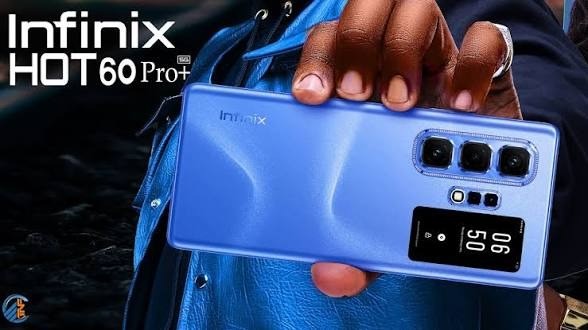
Image credit: Google
If the Spark 40 Pro wins on screen and stamina, Infinix answers with a phone that's almost absurdly thin. At under 6mm, the Hot 60 Pro+ is one of the slimmest phones you'll hold this year, and remarkably, Infinix didn't sacrifice battery capacity to get there. It still carries a 5,160mAh battery with 45W charging, plus a curved AMOLED display that matches the Tecno for brightness and smoothness.
Where it separates itself is durability. The Hot 60 Pro+ carries an IP65 rating, a real upgrade from the splash resistance you'll find on most budget phones, which means it can handle far more than an accidental spill. That matters if your commute involves dodging Lagos rain or dusty upcountry roads on a regular basis. The 50MP Sony sensor on the back also does a credible job in daylight, supported by a decently sharp 13MP selfie camera up front.
The trade-off is storage flexibility: there's no microSD slot, so whatever capacity you buy is what you're stuck with. Some retailers also list a lower-spec LCD version alongside the AMOLED model, so it's worth confirming exactly which variant you're paying for before checkout. If design and toughness matter as much to you as raw performance, this is worth the ₦290,000 to ₦345,000 it typically costs in Nigeria, or roughly KSh 23,000 to 27,600 in Kenya.
Samsung Galaxy A17 5G: the phone that thinks about next year

Image credit: Google
Tecno and Infinix chase specs, but Samsung bets on longevity. The Galaxy A17 5G ships with a promise of six years of OS upgrades and security updates, a figure that sounds almost unbelievable in a segment where most phones are lucky to see two. Buy this phone in 2026, and Samsung says it'll still be receiving security patches around 2031, which means your banking apps keep working, your browser stays current, and you're not forced into an early upgrade just because the software gave up on you.
That focus on the long game doesn't mean it lacks in other areas. The 6.7-inch Super AMOLED display runs at 90Hz, a notch below its Chinese rivals but still noticeably smoother than the 60Hz panels found on cheaper phones. The bigger surprise is optical image stabilisation on the 50MP main camera, a feature usually reserved for pricier devices, which translates into steadier video clips and noticeably better low-light shots when your hands aren't perfectly still.
Where it falls behind is charging speed. 25W is fine, not fast, and the Exynos 1330 chip inside won't excite anyone chasing high frame rates in mobile games. But that's not really who this phone is for. Families who don't want to think about phones for the next few years, first-time buyers, and small business owners leaning on mobile banking apps that need to stay current will get the most out of it. Pricing ranges from about ₦244,000 up to ₦330,000 in Nigeria, and around KSh 21,999 in Kenya.
Samsung Galaxy A07: the same philosophy, a smaller bill

Image credit: Google
If the A17 5G is Samsung's statement phone in this segment, the Galaxy A07 is its answer for people whose budget simply can't stretch that far. It carries the same six-year software promise, which is remarkable at this price, though it trades the AMOLED screen for a PLS LCD panel. Colours are flatter, and blacks aren't as deep, but the 90Hz refresh rate still makes everyday scrolling feel noticeably smoother than the 60Hz phones crowding this price bracket.
The phone is powered by a MediaTek Helio G99 chip, a genuine step up from what Samsung used to put in its cheapest phones, paired with a 5,000mAh battery that comfortably gets most people through a full day. The base 64GB storage option fills up fast once photos, videos, and app data start piling on, so it's worth stretching to the 128GB variant if your budget allows, or leaning on the microSD slot that supports up to 2TB of expansion.
This is the phone to point a student or a first-time smartphone buyer toward when the budget is tight but the desire for a trustworthy brand and years of updates isn't negotiable. It typically sells for ₦135,000 to ₦180,000 in Nigeria, and roughly KSh 11,000 to 15,000 in Kenya.
Xiaomi Redmi 15C: for when the power keeps going out

Image credit: Google
Every list like this needs a phone built around one obsession, and for the Redmi 15C, that obsession is battery life. Xiaomi crammed a 6,000mAh cell into this phone, and it shows. Light users can realistically stretch it across two days, while heavy social media users will still comfortably make it through one long day without hunting for a socket. Paired with 33W charging, topping up doesn't take forever either, which matters a lot when the power supply itself isn't something you can count on.
Xiaomi also resisted the urge to strip out extra features that budget buyers actually use. There's a proper 3.5mm headphone jack, a dedicated microSD slot separate from the SIM tray, and IP64 splash resistance thrown in for good measure. The 6.9-inch display runs at up to 120Hz, though the resolution is modest for a screen that size, so text and images won't look quite as crisp as on the AMOLED phones further up this list.
The one thing to know going in is that Xiaomi hasn't committed to the kind of multi-year update promise Samsung offers, so don't expect the same software longevity. But if your priority is simply never running out of charge, especially in areas where the power supply can't be trusted, this phone earns its place. Prices range widely depending on the sale, from around ₦135,000 up to ₦230,000 in Nigeria.
Itel Super 26 Ultra: looking the part on a budget

Image credit: Google
itel has spent the last few years quietly closing the gap between "cheap phone" and "phone that looks expensive," and the Super 26 Ultra is its clearest evidence yet. The curved AMOLED display, the slim 6.8mm body, the under-display fingerprint sensor: put it next to a flagship from across the room and most people wouldn't spot the difference. Peak brightness reaches an impressive 4,500 nits, so visibility in direct sunlight isn't an issue, and Gorilla Glass 7i along with an IP65 rating means it should survive the occasional accidental drop better than most phones in this price range, although a protective case is still a smart idea.
The 32MP selfie camera is the other standout here, tuned clearly with social media in mind, and it shows in the results compared to rivals stuck at 13MP or lower up front. Battery capacity sits at a healthy 6,000mAh, though charging tops out at a comparatively slow 18W, so expect longer waits when you do need a top-up.
The Unisoc chipset starts to show its limits during demanding gaming sessions, warming up faster than the MediaTek and Exynos alternatives on this list., warming up faster than the MediaTek and Exynos alternatives on this list. Itel also hasn't been explicit about how many years of software updates to expect, which is worth keeping in mind if longevity matters to you. Still, for anyone who wants to look like they're carrying a premium phone without paying premium prices, especially if selfies and screen quality top your priority list, it's worth considering. Expect to pay between ₦217,000 and ₦260,000 in Nigeria, or KSh 20,500 to 25,000 in Kenya.
A few things worth knowing before you buy
Battery size should be the first number you check, not the last. Anything below 5,000mAh is a hard pass unless you're somewhere with genuinely reliable power all day. In areas where outages are routine, a 6,000mAh battery paired with decent fast charging is worth more than an extra camera lens you'll rarely use.
Dual SIM support matters more here than in most markets, since plenty of people run two lines, one for calls and one for data, to manage costs across networks. Every phone on this list handles that without issue.
If you're eyeing a 5G phone, it's only worth the extra cost if your network actually covers your area with 5G. Otherwise you're paying for a feature that sits dormant, and a strong 4G phone will serve you just as well day to day without the premium.
Storage disappears faster than people expect. Between WhatsApp media, TikTok downloads, Facebook, and photos, 64GB fills up within months. Go for 128GB if your budget stretches that far, or make sure there's a microSD slot to fall back on.
Mobile money and banking apps generally aren't picky about hardware, but very old or heavily modified versions of Android can occasionally cause compatibility headaches. Every phone here runs Android 14 or 15, so that shouldn't be a concern.
And before you hand over your money, ask about spare parts and after-sales service, not after something breaks. Samsung and Tecno both maintain wide service networks across major African cities. Some smaller brands don't, and a simple screen repair can turn into a long wait or an expensive import when that's the case. Buying from a retailer that offers a real warranty, even if it costs a little more than the roadside seller offering a "London used" deal, tends to pay for itself the first time something goes wrong.
POCO C85: Big value on a budget

Not everyone shopping for a new phone has ₦200,000 to spend. For many students, first-time smartphone buyers, or anyone with a budget, even ₦100,000 can feel like a big investment. That's exactly where the POCO C85 comes in.
It focuses on the features people actually use every day. Whether you're chatting on WhatsApp, scrolling through TikTok and Facebook, watching YouTube videos, attending online classes, or checking your banking app, it gets the job done without making your wallet cry. If you're a student, the large display is a welcome bonus. It makes reading PDFs, lecture notes, e-books, and research materials much more comfortable, especially during long study sessions. The battery is another reason to like it. It comfortably lasts a full day on a single charge. The large display also makes watching movies, reading messages, and browsing social media much more enjoyable than you'd expect from a phone in this price range.
Of course, there are a few compromises. The camera does its best work in good lighting, so don't expect stunning night shots. And while it handles everyday tasks with ease, it's not designed for heavy gaming or demanding apps. But it’s honestly a fair trade-off when you consider how little you're paying.
If your goal is to buy a reliable smartphone without stretching your budget, the POCO C85 is one of the easiest phones to recommend. It proves that you don't have to spend a fortune to stay connected and enjoy a smooth everyday smartphone experience.
So, which one should you actually buy?
If you want the best all-round balance of screen, battery, and performance, the Tecno Spark 40 Pro is hard to beat. If long-term reliability matters more to you than chasing specs, Samsung's six-year update promise on the Galaxy A17 5G, or the more affordable Galaxy A07, is difficult to match anywhere else in this price range. Anyone whose biggest fear is running out of battery mid-day should look straight at the Xiaomi Redmi 15C. If design and durability top your list, the Infinix Hot 60 Pro+ delivers a phone that looks and feels far pricier than it is. If you care most about your selfies and want a screen that dazzles, the itel Super 26 Ultra holds its own against phones costing considerably more.
None of these phones will cost you more than a mid-range laptop, and each one comfortably handles what actually matters day to day: WhatsApp, mobile banking, social media, and enough camera quality to keep the moments worth keeping. Compare them based on what you'll actually use the phone for, not just the spec sheet, and you won't go wrong.
Prices are estimates based on multiple retailers as of mid-2026 and vary by country, market prices, and exchange factors. Always confirm current pricing before purchase. Happy buying!