
Africa’s fintech race has officially moved beyond "growth at all costs." In 2026, the hype has settled, and the real question is no longer who can launch the fastest, but who can actually stay profitable. At the centre of this battle for dominance are Flutterwave and Chipper Cash, two companies that have helped define modern digital payments across the continent.
Both have raised massive funding and built household names. But scaling" in 2026 means more. It’s now about the "boring" but very important infrastructure, sustainable revenue, and staying on the right side of regulators.
So, between Flutterwave’s push into open banking and Chipper Cash’s pivot to positive cash flow, who is actually winning the race? Let’s break down what scaling looks like in the African fintech market today and which company is built to last.
How The Two Business Models Driving Growth
Flutterwave built its reputation as a payments infrastructure company. Its focus has been on helping businesses to accept and process payments across Africa. By positioning itself as the rails behind digital commerce, it embeds deeply within merchant ecosystems.
Chipper Cash began with a consumer-first model. Its early growth was driven by peer-to-peer transfers and remittances. It focused on making cross-border transactions seamless for individuals before expanding into broader financial services.
The difference in model shapes the kind of scaling each company achieves. Infrastructure-led scaling tends to build institutional dependency. Consumer-led scaling builds brand visibility and retail penetration. But it also requires constant engagement, retention, and operational discipline.
One model builds backend power. The other builds frontline adoption.
Expansion Across African and Global Markets
When people talk about African fintech expansion, they usually focus on the number of countries a company operates in. But expansion is not just about planting flags on a map. It’s about getting permission to operate, staying compliant, and surviving tough regulatory environments.
Both Flutterwave and Chipper Cash have pushed aggressively into new markets across Africa and beyond. They’ve expanded into key economies like Nigeria, Kenya, South Africa, and even built corridors connecting Africa to the US and Europe to strengthen cross-border payments in Africa.
But expansion in 2026 is not just about growth. It’s about fintech licensing in Africa and regulatory approval.
For example, Flutterwave has had to secure multiple payment licenses in different countries to continue operating legally. In highly regulated markets like Nigeria and Kenya, fintech companies must meet strict central bank requirements around capital reserves, reporting standards, and anti-money laundering compliance. That process can take months, sometimes years.
Chipper Cash has also faced regulatory adjustments in some markets, especially as African governments tighten rules around digital wallets, remittances, and foreign exchange transactions. In recent years, regulators across Africa have become more cautious about fintech platforms handling large cross-border flows without strong oversight.
This is where the real test of scaling happens.
A fintech company can announce entry into ten countries. But if it struggles with regulatory compliance in fintech, delays in licensing, or sudden policy shifts, that expansion becomes fragile.
In today’s environment, depth matters more than width.
Operating smoothly in five countries with full regulatory approval and strong banking partnerships may be more powerful than operating lightly in ten.
In 2026, real scale means licensed operations, stable banking relationships, strong compliance systems the ability to adapt when regulators change the rules because in Africa’s evolving fintech ecosystem, regulation is no longer an obstacle, it's a filter. And only the most disciplined players pass through.
Product Ecosystem and Innovation Depth
In fintech, product expansion reflects strategic ambition.
Flutterwave continues to deepen its merchant ecosystem, expanding beyond payments into data, identity, and trade enablement. Its acquisition of Mono signaled a push into open banking and financial data infrastructure, reinforcing its backend positioning.
Chipper Cash has focused on refining its consumer engine. After a period of aggressive expansion, it shifted toward efficiency, reducing burn and prioritizing positive cash flow in late 2025.
That pivot was not just financial, it was strategic.
While infrastructure players compete on integration and compliance strength, consumer fintechs compete on cost control, engagement, and trust.
The Sustainability Question
Rapid expansion brings costs. Licensing, compliance, staffing, and technology infrastructure require continuous investment.
The fintech that balances growth with financial discipline may ultimately scale more effectively than one expanding aggressively without structural stability.
Scaling in 2026 is not about speed alone. It is about resilience.
So Who Is Scaling Faster
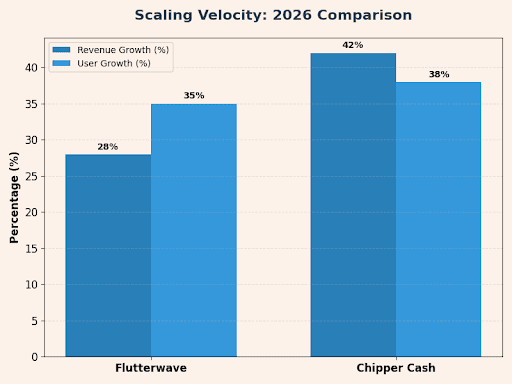
The answer depends on how you measure speed.
If scaling is measured by visibility and expansion headlines, both companies appear competitive.
If scaling is measured by infrastructure integration, regulatory positioning, and long-term revenue strategy, the answer becomes more complex.
Flutterwave’s infrastructure focus suggests deep structural embedding. Chipper Cash’s consumer growth reflects strong retail penetration.
The more important question may not be who is scaling faster but who is building a system that can endure Africa’s evolving regulatory and economic landscape.
And that story is still unfolding.
Conclusion
The competition between Flutterwave and Chipper Cash reflects a bigger shift happening across African fintech. The days of chasing massive valuations and expanding at any cost are over.
Flutterwave’s acquisition of Mono and its strong push into stablecoin-powered B2B payments show a company determined to become the invisible backbone of Africa’s digital economy. It’s not just about processing transactions anymore. Flutterwave is building the system's data, identity, and payment rails that make those transactions possible.
Chipper Cash, on the other hand, tells a different but equally powerful story. After a tough period marked by layoffs and market pressure, the company reached positive cash flow in late 2025. By focusing on profitability and efficiency instead of rapid expansion, Chipper Cash proved that a consumer-first fintech model can survive currency volatility and economic shocks.
So, who is scaling faster? It depends on how you define speed. If scale means expanding influence and building deep infrastructure, Flutterwave is moving aggressively. If scale means building a sustainable, profitable engine that can weather uncertainty, Chipper Cash is advancing with discipline.
In 2026, however, the real winners are Africa’s fintech users. Whether it’s a merchant in Lagos paying overseas suppliers through stablecoin-powered platforms, or a student in Kampala making seamless cross-border payments, the result is the same: a more connected, efficient African economy.
The era of “growth at all costs” is over. What we’re seeing now is growth that is smarter, stronger, and built to last.
Enjoying our content follow us on our media platforms to get even more interesting content
Don’t miss out on what’s trending in tech 🔥
Follow The Nxt Box on social media